

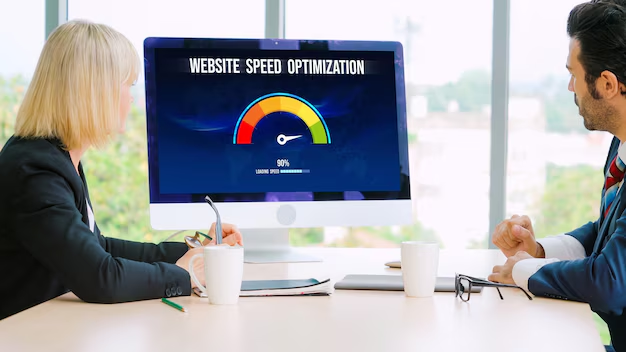
Speed is all that is required in the digital world. Once people find themselves on your site, they make the decision of whether to remain or to keep off within a few seconds, and page load time contributes significantly to the decision. Research indicates that a page that takes a period of over three seconds to load is likely to lose over 50 percent of its traffic. When doing business in such a bustling city as Dubai, where businesses are fast-paced and customers expect a lot, losing traffic is not the only cost associated with slow sites; credibility and revenue can also be lost. Speed optimization does not only concern the technical performance of the website, but the challenge of websites is to offer their users an efficient and straightforward experience that makes them interested in the sites even after clicking the very first time.
Why Website Speed Matters
The speed of your site has a direct influence on all other elements of your presence on the Internet. It affects user experience, search engines, and eventually your conversion rates. An expedited site sends the message of professionalism, reliability, and trustworthiness. When the users are able to move around without delays during page loading, there are chances that they will explore, interact, and make a purchase.
Technically, Google utilises page speed to rank information, so faster websites have more chances to find their places at the top of search. In competitive markets such as the online world of Dubai, where companies are competing to have a web presence, a delay of a single second can spell the difference between success and a lost chance. A slow site not only frustrates the users but also puts them right into the hands of your competitors.
The Impact of Slow Load Times
The impact of delay in the performance of the websites might be small, but the consequences are huge. Conversions can even be decreased by 7% in terms of every additional second of loading. Can you imagine that you might have potential clients and your home page takes a long time to load, making you lose them? Reduced websites also have increased bounce rates; that is, the number of people who visit before interacting with your site or goods.
On top of frustrating the users, a slow site hurts brand image. When the market is focused on instant performance, visitors tend to relate the performance of the websites with the efficiency of the businesses. In the case that your website looks old-fashioned or is slow, your visitors might think that your products or services are old-fashioned. On the contrary, a high-speed and quick site means a brand that appreciates the time and experience of its customers.
What Matters: Your Website Speed
There are a number of reasons that make your site load slowly or fast. Among the most frequent offenders are the large, unoptimized images that require too much time to render. The other problem is bad hosting, in which the response time of the servers is slow or erratic. Also, overuse of or unnecessary plugins, too much JavaScript, and bloated code will slow down your site.
Speed is also dependent on caching and content delivery networks (CDNs), as well as the structure of the entire site. An example is when a site is stored in one local server, it would automatically be slower to an international user than one that is served by a CDN that spreads its content across the world. The first thing to do in order to enhance the load time of your site is to understand these elements.
The Part of User Experience in the Optimization of Speed
The speed of the website is closely related to user experience (UX). The speed of navigation is made easy as users browse a fast site, and this motivates them to spend more time and visit more. In contrast, snail shifts and lags interrupt that flow, resulting in frustration and swift plane exits. Speed is an essential element of the Dubai business environment, where customers demand a luxurious level of service even in the context of online business.
An optimised site creates confidence and a desire to visit it again. Quick loading images, scrolling, and responsive design make your brand seem efficient and give a nice browsing experience. As soon as users have the feeling that their time is appreciated, they will be much more willing to engage, subscribe, or purchase.
The Influence of Website Speed on SEO
User satisfaction is a priority for search engines, and speed is a significant component of the latter. The Core Web Vitals – a collection of performance, responsiveness, and visual stability measures—are used by Google Core Web Vitals, is a direct indicator of the ranking of your site. The websites that are faster tend to have more visibility and are more likely to be clicked through.
Slowing down of pages not only lowers the same in terms of organic ranking, but also, as far as crawl time is concerned, the longer it takes to load your pages, the longer it will take the bots of Google to index your pages. It is able to postpone updates and reduce the exposure of your new material. The issue of website speed is vital to the competitiveness of brands operating in the dynamic online market of Dubai, as it allows them to remain visible, increase their rankings, and stay top of the competition. The way your audience views your business is often their first impression of your website, and it is formed in a matter of seconds. A quick, streamlined site is not only attractive but also very efficient, positions higher, and sells better. In the modern digitalised world, where websites are fast, it is not an option but a necessity to optimise their speed.
Summary: Speed is the New Standard
The way your audience views your business is often their first impression of your website, and it is formed in a matter of seconds. A quick, streamlined site is not only attractive but also very efficient, positions higher, and sells better. In the modern digitalised world, where websites are fast, it is not an option but a necessity to optimise their speed.

Recent Comments